Super-Ellipse Control Barrier Functions for Enhanced Obstacle Avoidance in Complex Multi-Agent Environments
Wenbin Liu, Shucheng Jia, Mikhail Svinin
IEEE ICRAS 2025 · Undergraduate thesis, Ritsumeikan University · Advised by Prof. Wenbin Liu and Dr. Mikhail Svinin
Multi-robot intersection in Gazebo. Left: SE-CBF. Right: standard circular CBF.
Overview
For my undergraduate thesis I designed SE-CBF, a non-circular control barrier function for multi-robot collision avoidance. Control barrier functions (CBFs) are a standard tool for real-time safety, but they usually keep the same safety distance in every direction. Around rectangular or irregular obstacles that is too conservative: it blocks free space the robot could use, forces detours, and in crowded scenes leads to congestion. SE-CBF replaces the circle with a super-ellipse whose shape, size and orientation follow the obstacle, so robots keep a large margin where it matters and use the space where it doesn't.
Method
A super-ellipse is the curve (x/α)n + (y/β)n = 1. With n = 2 it is the circle used by standard CBFs; as n grows it approaches a rectangle, and α and β stretch it independently along each axis. The barrier is h(x) = 1 − ((Px − Ox)/α)n − ((Py − Oy)/β)n, which is non-negative exactly when the robot at P is outside the boundary around the obstacle centre O.
- Perception. A fixed overhead camera and OpenCV detect obstacles with color-threshold segmentation and bounding boxes. A pixel-to-world mapping then converts each detection into a 2D global frame with its origin at the center of the arena, giving the obstacle's position and size.
- Dynamic safety distance. A rotation matrix R(θ) aligns the boundary with the obstacle's orientation and a scaling matrix S sets its size, so each obstacle gets a super-ellipse constraint that matches its footprint. Both are updated continuously, so the boundary adapts in real time without re-planning the whole path.
- Control. A quadratic program (QP) optimizes the robot's navigation command so that it satisfies every safety constraint while staying as close as possible to the original motion toward the goal.
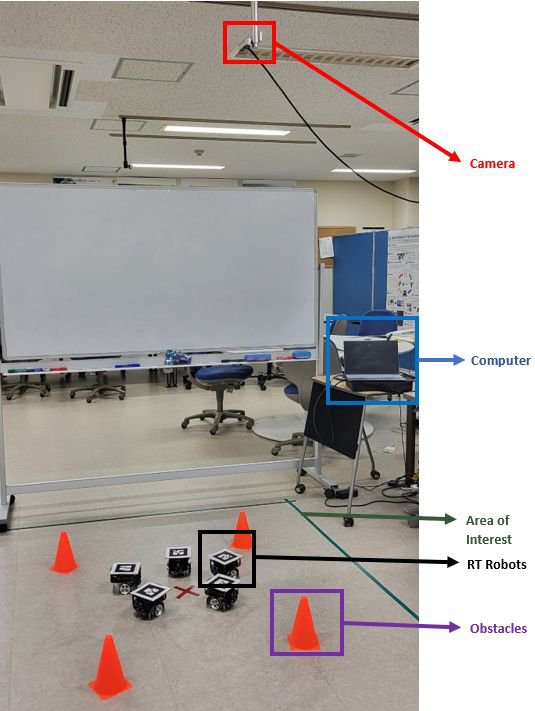
- System. A PC running ROS Noetic computes every robot's command and sends it over Wi-Fi to Raspberry Pi Mouse V3 robots running ROS Melodic. An Intel RealSense D435 mounted 2.3 m above a 2 m × 2 m arena tracks AR tags on each robot for real-time position feedback.
Top: a circular CBF boundary around an elongated obstacle. Bottom: the super-ellipse boundary fits the obstacle's shape.
Experiments
I tested SE-CBF in two Gazebo scenarios and on real robots:
- Roundabout intersection. Eight robots cross a two-lane roundabout at the same time, comparing SE-CBF with a standard CBF over 15 trials each.
- Unknown-area exploration. Groups of 4, 8 and 12 robots cross a field of randomly placed prisms, cylinders, cubes and ellipsoids. A standard CBF could not complete this scenario at any robot count, so here I studied how SE-CBF scales with robot density.
- Real robots. Four robots enter a one-lane intersection from four directions and pass a rectangular obstacle in the centre.
Random-obstacle environment: four robot teams cross to the opposite side (2× speed).
Real robots tracked by an overhead camera avoid the obstacle (purple box).
Results
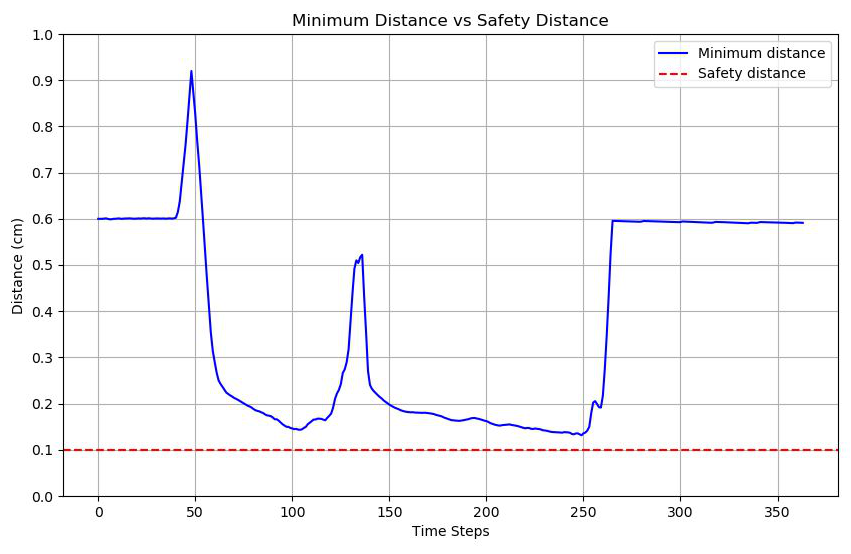
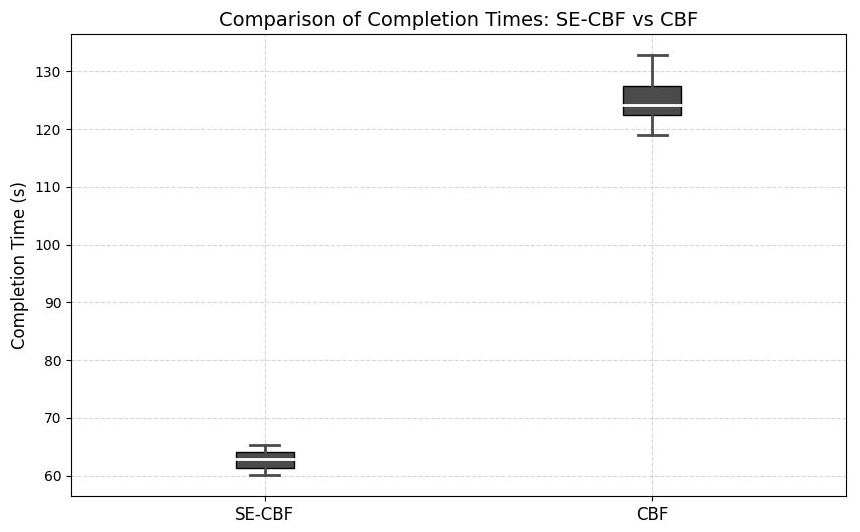
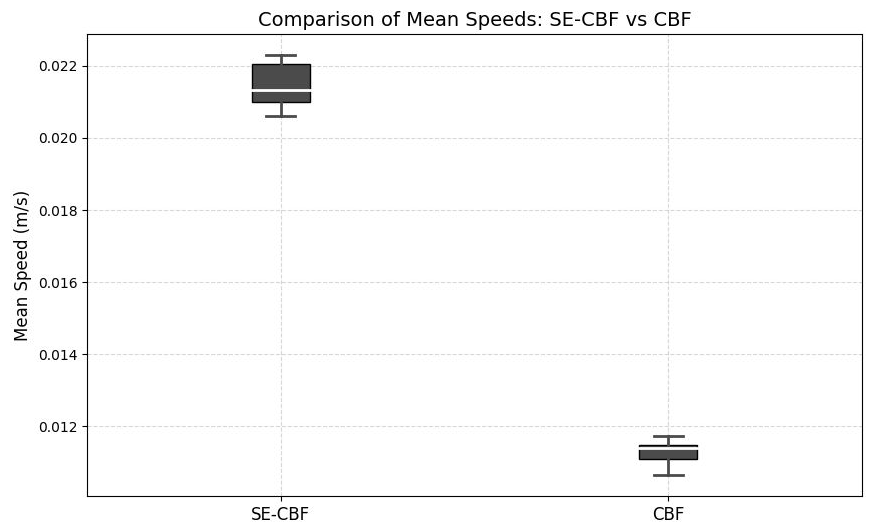
At the roundabout, SE-CBF cut the median completion time from 123 s to 62 s and roughly doubled the robots' mean speed (median 0.0215 m/s vs. 0.0115 m/s) compared with the standard CBF. It did this without giving up safety: the average minimum distance to obstacles and other robots was 0.45 m with SE-CBF versus 0.35 m with the standard CBF, both above the 0.3 m safety distance.
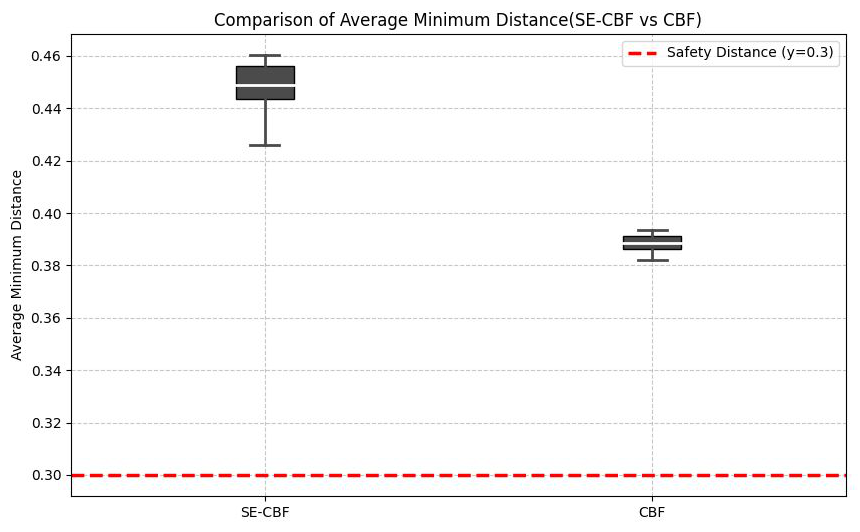
In the exploration scenario, SE-CBF completed the task with all three group sizes: about 42 s with 4 robots, 52 s with 8 and 55 s with 12. Path length grew only modestly with density (about 7.8 to 9.0), and the minimum distance stayed above the safety threshold in every run, even with 12 robots. Across the scenarios, path redundancy dropped by 20–30% compared with a fixed safety distance.
On the real robots, all four passed the central obstacle and reached their goals in about 45 s with no collisions.